Every photograph has its own place here. Browse the family visits, celebrations and quiet moments, then spend more time with the stories from the memoir.
Some lives are measured in milestones. His is also measured in the things he made possible for others.
Meet P. M. Prakash: engineer, maker, family man and philanthropist. Explore his life, stories and family photographs in this companion to his memoir.
To his family, he is simply PMP. A builder, a problem-solver, a quiet source of strength. Born in Nandi in October 1938, Sri P. M. Prakash has carried a child’s curiosity through a life of engineering, entrepreneurship, family, and service.
This is an invitation to spend time with that life. To wander through its places, meet the people at its centre, and discover the small and large acts of ingenuity that make it his own.
Two intense years of learning began when Narendra was nine and Prakash twenty-two. Reading, keys, circuits, soldering and candle boats made a shared education.
The boy from Nandi, and Chandra, Prakash, Ramakrishna, Sunitha, Indira and Ammanni together at Jog.
The boy from NandiNandi · childhoodThe first circleJog · late 1940s
1960
Engineer
Prakash at his engineering convocation.
Engineer1960
Early 1960s
Everyone came along
A family vacation beside two cars; the pleasure of going together.
Everyone came alongEarly 1960s
1963
Prakash and Shantha
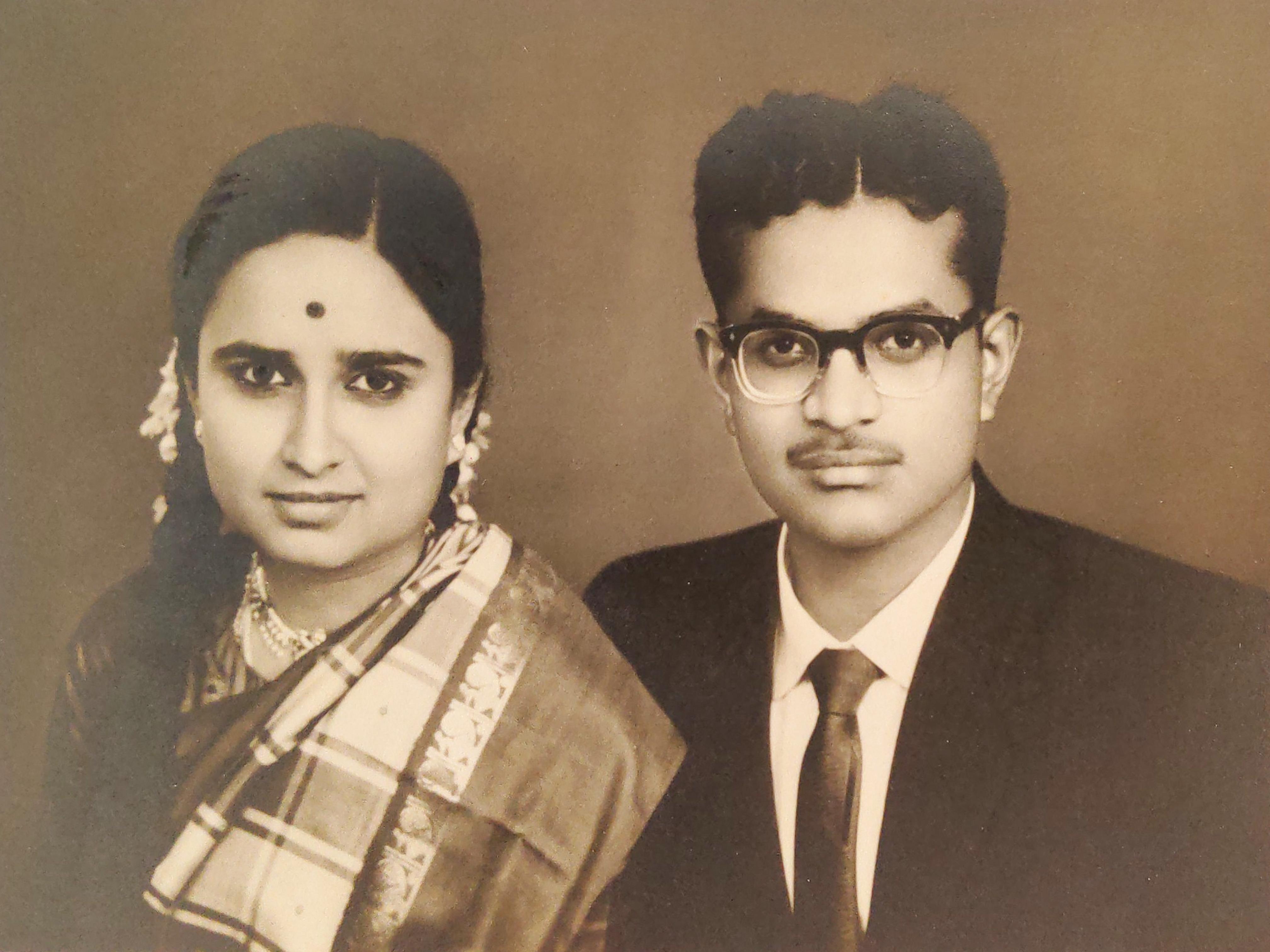
Their wedding, with family and friends, and their wedding portrait.
Prakash and Shantha1963Shantha and Prakash1963 · wedding portrait
4 January 1999
The photographs come out
Prakash and his brother Ramakrishna revisit the family album.
The photographs come out4 January 1999
4–5 January 2001
Together in Coorg
Narendra and Nishi visiting Prakash and Shantha; family time together in Coorg.
Together in CoorgCoorg · 4 January 2001An afternoon in CoorgCoorg · 5 January 2001
June 2001
A family visit to Nandi
Narendra and Nishi’s visit, Shantha, the wider family and the grandchildren: making things and spending time together.
A windy day on the hillNandi Hills · 2 June 2001Guiding Pranav’s hands2 June 2001Three grandchildren2 June 2001No hurryNandi · June 2001
30 December 2002
The family at Mysore Palace
Prakash and Shantha with Prashanth, Amitha, Narendra, Nishi and two grandchildren.
The family at Mysore PalaceMysore Palace · 30 December 2002
Discovery Village · after 2005
An idea becomes a place
Prakash at Discovery Village, a family enterprise built around nature, learning and curiosity.
An idea becomes a placeDiscovery Village · after 2005
15 February 2009
A growing family
Shantha and Prakash with Anu, Jeanette and Isabella.
A growing family15 February 2009
Around 2011
A quiet moment
Prakash relaxing with a cup of coffee.
A quiet cup of coffeeAround 2011
18 December 2013
The family gathers again
Prakash with Nishi, Narendra, DoddaMava, Hareesh and Hareesh’s wife.
The family gathers again18 December 2013
November–December 2015
Around the family table
Sunitha, Indira, Susheela and Sampath, a larger family gathering, and Suri visiting with his son Mark.
With Sunitha29 November 2015At the family table29 November 2015The whole family, together29 November 2015Suri and Mark9 December 2015
Around 2016
A shared language
Prakash and granddaughter Anvitha working together.
Working togetherAround 2016
Nandi · 28 January 2017
Ramakrishna turns eighty
Brothers remembering, family around the cake and table, and three generations together.
With ChandraNandi · 28 January 2017Ramakrishna and AnuNandi · 28 January 2017Ramakrishna turns eightyNandi · 28 January 2017Ramakrishna’s 80th birthdayNandi · 28 January 2017Brothers, rememberingNandi · 28 January 2017The family tableNandi · 28 January 2017Three generationsNandi · 28 January 2017Anvita, always thereNandi · 28 January 2017
4 February 2018
The conversation continues
Prakash with brother-in-law Hanumaiah and brother Ramakrishna.
The conversation continues4 February 2018
11 November 2021
Anvita’s wedding
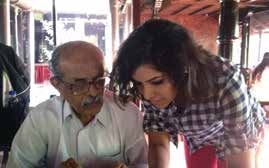
The family assembles; Prakash finds time for conversations with Anvita, Narendra and Suri.
The family assembles11 November 2021Grandfather and granddaughter11 November 2021A word with Anvita11 November 2021With Narendra11 November 2021With Suri11 November 2021
November 2021
Chandra and Hanumaiah with Prakash
Chandra and Hanumaiah share time with Prakash.
With ChandraAround November 2021With Hanumaiah11 November 2021
13–14 November 2021
The siblings together
A quiet conversation with Suri, then the brothers and sisters gathered at Sunitha’s home.
With Suri13 November 2021The siblings togetherSunitha’s home · 14 November 2021
November 2023
Still working an idea out
Prakash builds a paper-and-pipe hydraulic model, then gives directions with cousin Sudheer and the team listening.
An idea in his hands24 November 2023Still directing the workDiscovery Village · 28 November 2023
30 November 2024
Still at the centre
Prakash with Anu, Chandra, Indira, Anitha and Rajiv.
Still at the centre30 November 2024
Approximately 2024–2026
Four generations
Prakash with his sons, daughters-in-law, granddaughter Anvita and great-grandson Kabir.
Four Generations Founded by PMPApproximately 2024–2026
Further stories
The chapters behind the glimpses.
1938
A small village.
An expanding world.
Born in Nandi in October 1938, the second of seven children, Prakash soon moved with his family to Jog Falls, where his father, Patrenahalli Mariappa, was an electrical engineer. His mother, Lakshmamma, brought her own skilled hands and pleasure in learning to the home.
PMP’s educational story began with his father’s. When Mariappa’s college education seemed out of reach, his sister-in-law Hakkalamma sold her gold jewellery to help him study. Mariappa became an electrical engineer. That act of generosity would echo through the next generation.
While his father was in the UK, Prakash returned to Nandi to stay with his grandparents. Extra coaching and his maternal grandmother’s care helped steady his schooling. He remembered the long, smoky train journey from Talaguppa and the sadness of leaving home.
Back at Jog, dams, factories and generating stations became an open classroom. The books and Meccano set his father brought from England gave that curiosity something to work with.
The Blessed One · printed pages 1–9
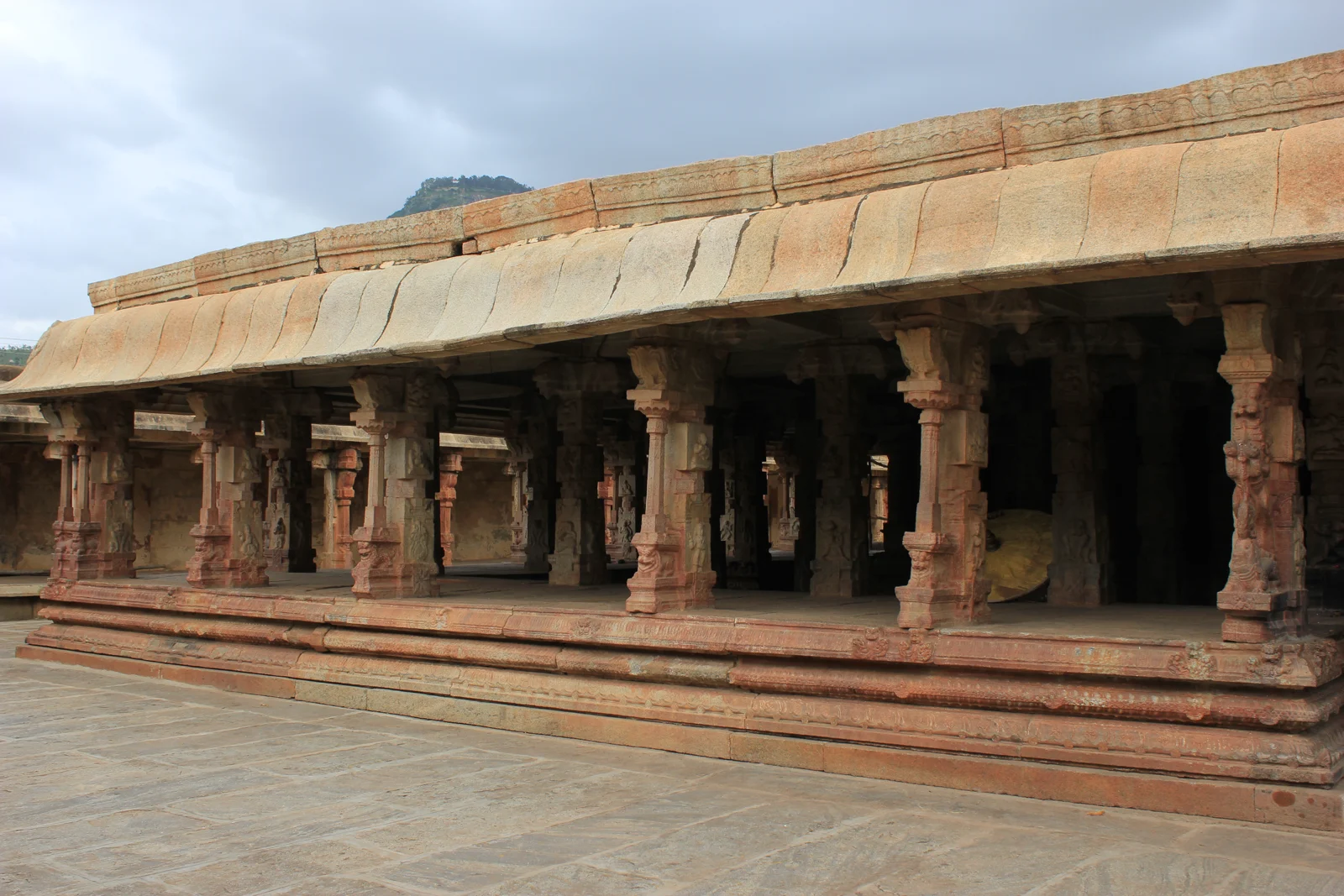
Dineshkannambadi · CC BY-SA 3.0
1960
Learning how
the world works.
A friend of Mariappa came forward to advance the one-thousand-rupee admission contribution that made it possible for PMP to enter BMS College of Engineering in 1956.
He chose mechanical engineering. His college years brought friendships that endured for decades, among them his bond with Shivakumar. Educational trips and later technical discussions gave the friendship a shared language.
On graduating in 1960, PMP joined HMT’s planning department. He helped establish time standards in the foundry. It was work that rewarded attention, observation and precision.
His brother Narendra remembered the pride the family felt when the HMT bus came to the house. Leaving that security later was a consequential choice. The same mind that wanted to understand a machine also wanted to build something of its own.
The Blessed One · printed pages 9–15
HMT
1963
A home full
of belonging.
Prakash and Shantha married in 1963. With their sons Prashanth and Praveen, they built a home that made room for family, friends and shared adventures.
Shantha’s cooking and hospitality were at the heart of the home. PMP’s precision found its place in family outings too: planning ahead, buying the cinema tickets, making time for the weekend.
His sons remember restaurant visits on MG Road, films and the bandstand in Cubbon Park. Family travel brought them to places across India and, later, to Europe and the United States. The pleasure lay as much in being together as in the destination.
His affection was often practical. Books, tools, an explanation, a solution at the right moment: these were familiar ways he showed care. His grandchildren remember being taken seriously, encouraged to experiment and taught to look closely.
The Blessed One · printed pages xii; 17–35
Family photograph · 1963 wedding portrait
1965
A founder. A startup.
Before the buzzwords.
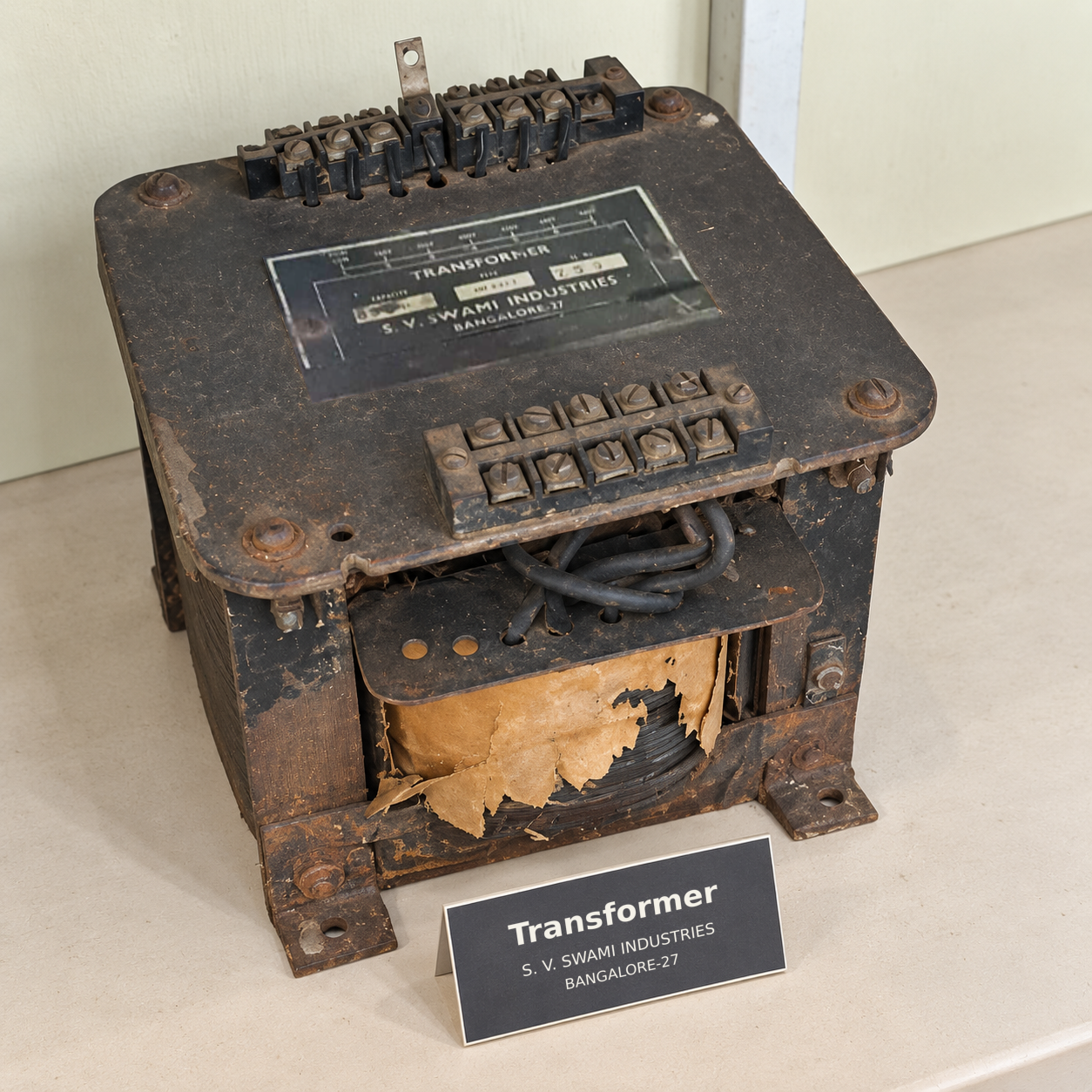
In 1965, S.V. Swami Electronics and S.V. Swami Industries began as an ITI ancillary unit. Transformer work led to new opportunities; solving the problem of fading labels led to a durable nameplate business.
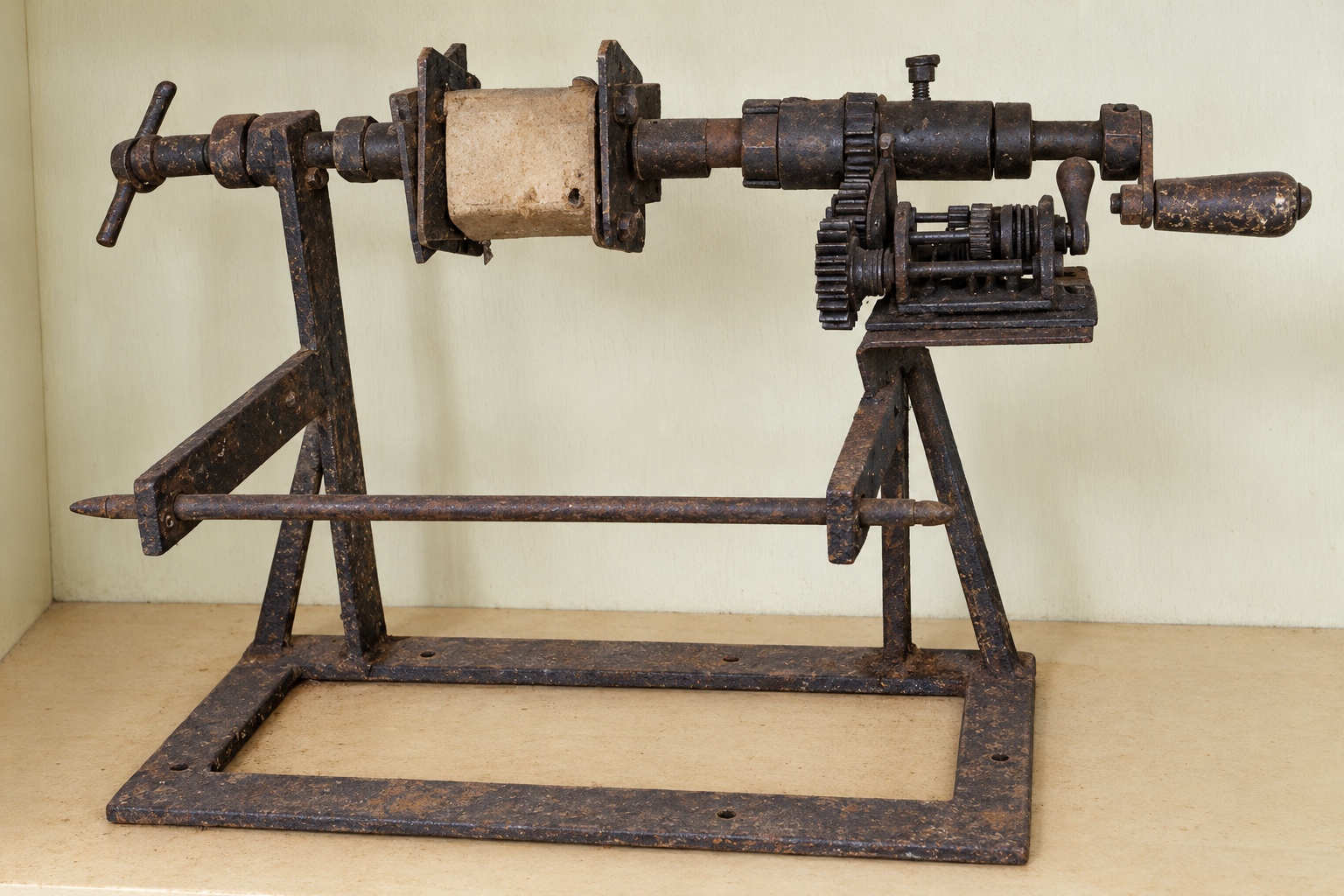
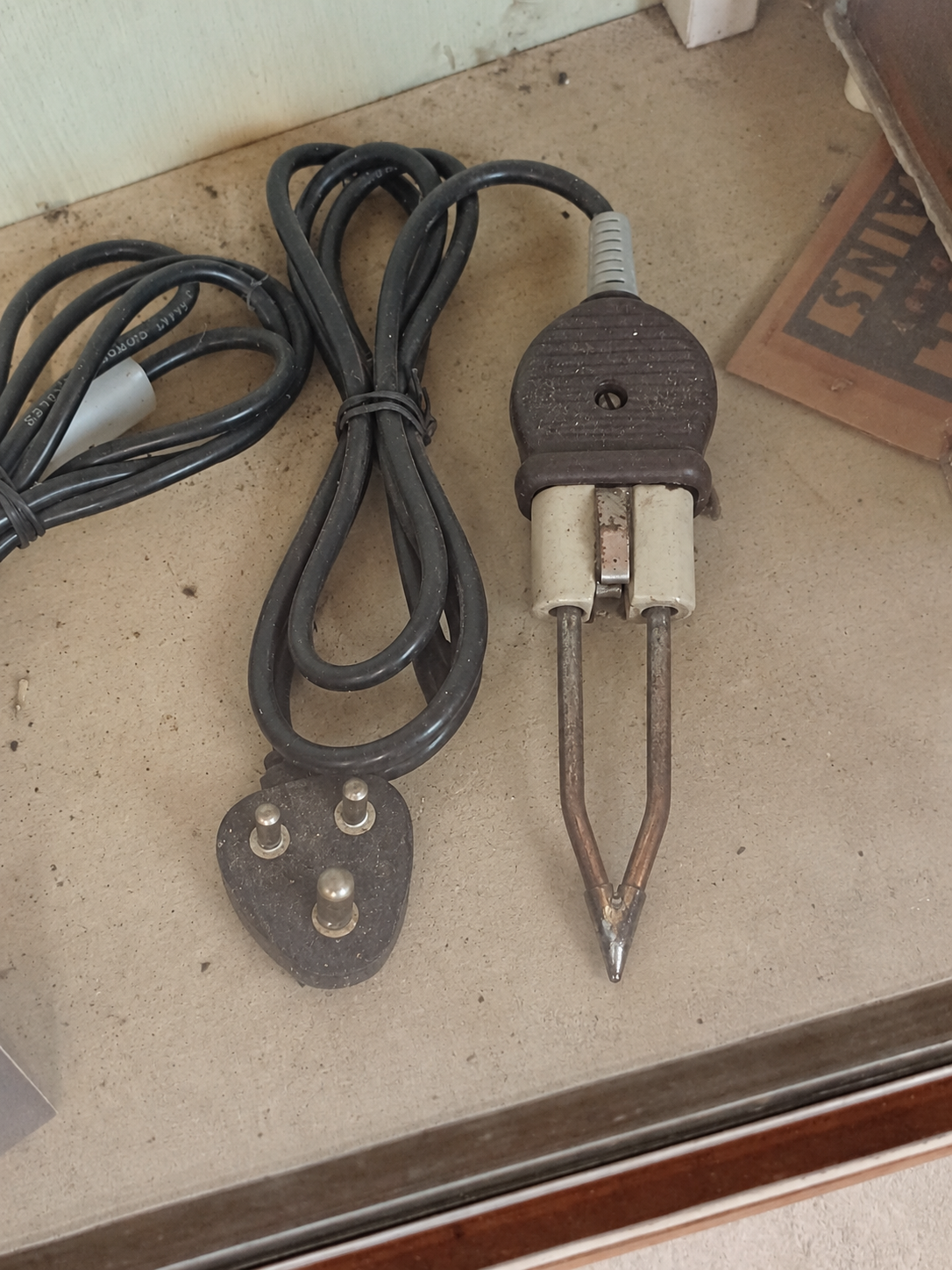
After leaving HMT, Prakash set up his own workshop. He recalled an order for one hundred transformers from HMT’s Kerala unit, a hand-winding machine he fabricated, borrowed working capital and a wooden cot pressed into service as a table. Narendra remembers him making soldering irons for NGEF.
When anodized labels faded, Prakash used black-painted metal sheets protected with PU lacquer. S.V. Swami grew into a supplier of nameplates for equipment manufacturers, offering printed, engraved, acid-etched, laser-engraved and heat-transferred labels.
For an early fuse unit, he bought parts separately: silver-plated brass screws from a rolling mill, and porcelain bases from the government factory with his father’s help. The fuse type had been superseded by the time he approached the purchasing department, so the product went unsold. Winning industrial orders and getting products through inspection also took persistence; he had little interest in the club and bar networks through which business contacts were often made.
He increased his power press’s capacity with progressive shearing tools and used plotted vinyl stickers as masks for etching brass plates. Praveen, his younger son, left medical practice to join the business without an engineering background. Prakash guided him as he learned; Praveen eventually took over the management.
PMP’s willingness to learn did not end with his formal education. In 1986 he bought a computer. He later learned programming at SPAN and developed a dBase system for the business. The memoir also records his move to computerised diary entries in 1987.
In 1995, he and Prashanth began another enterprise around a computer-controlled engraving machine that Prashanth had brought from the United States. New tools kept arriving, and PMP kept finding out what they could do.
The Blessed One · printed pages 12–15; 29; 81–83
2005
A village
of possibilities.
In 2005, PMP, Prashanth and Amitha founded Discovery Village. Kanakapura came first, followed by Nandi Hills and Kabini. Nature, hands-on learning and resourceful building met in one family collaboration.
Prashanth and Amitha imagined a place away from city routines, where children and families could reconnect with nature. For PMP, it offered a chance to bring his architectural ideas to life. Their interests met in Discovery Village.
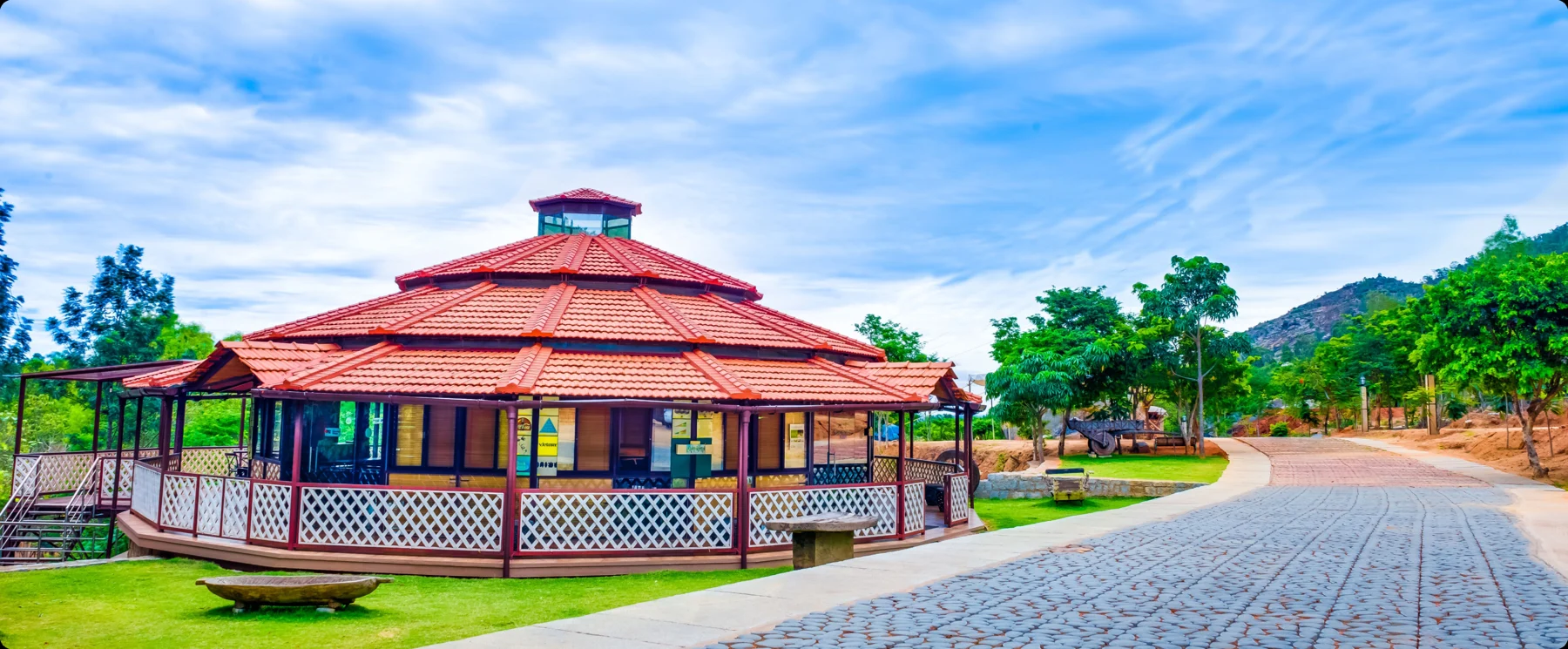
At Nandi, the old railway station inspired a reception building. A hexagonal cottage used steel panels; salvaged eave boards and recycled packing wood found new purpose. Practical constraints were invitations to design.
The memoir names the Patrenahalli Mariappa Illusion Gallery at Discovery Village, Nandi, in memory of PMP’s father. Optical illusions and science models carried forward the family’s delight in things that make you stop and ask how they work.
These places also held ordinary family pleasures: meals brought from home, visits from grandchildren and time with old friends. After Shantha’s death, visits to Discovery Village with Shivakumar became occasions for conversation and scriptural study, carrying a friendship formed in engineering college into another season of life. For PMP, the project’s engineering and its human life belonged together.
The Blessed One · printed pages 69–79
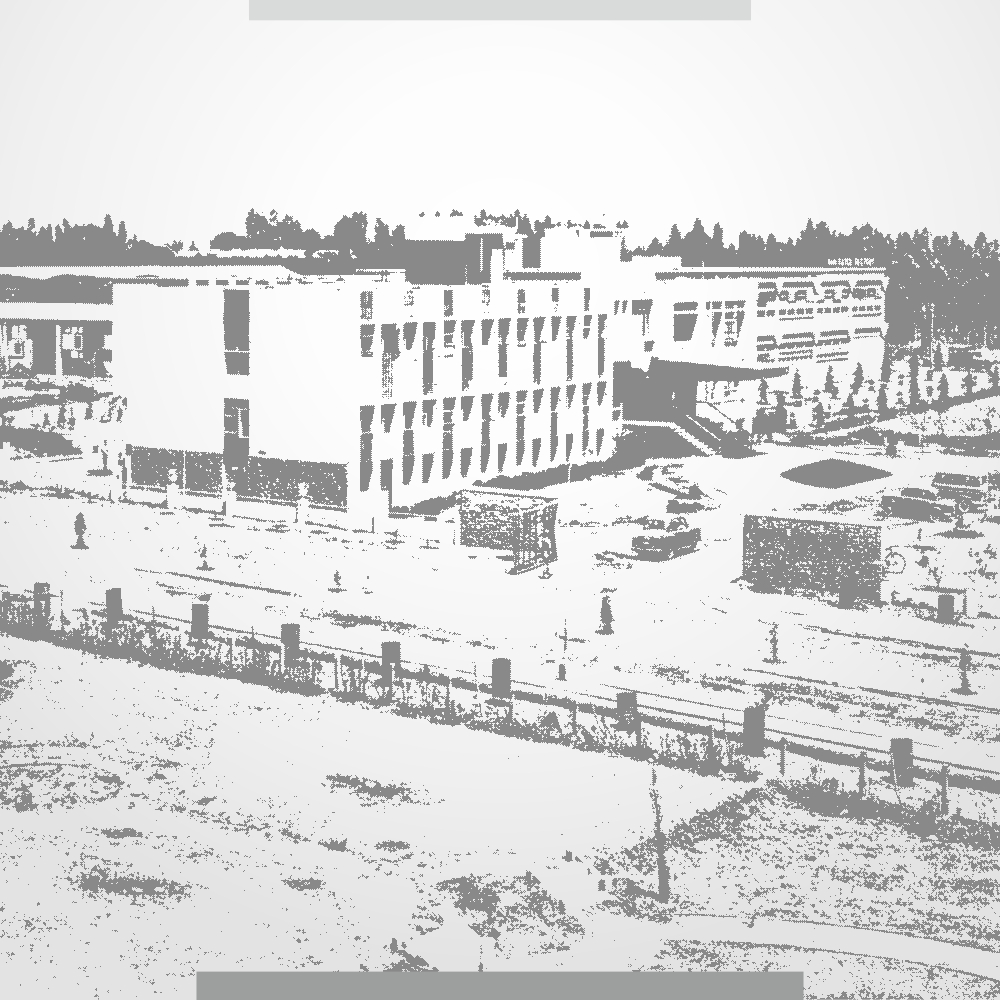
Discovery Village · official Nandi Hills gallery
A lifetime
Making room
for someone else.
From food donations and school equipment to educational support and a family trust, PMP found practical ways for help to continue beyond a single gesture.
During a difficult period in business in 1974, PMP began donating food to Abalashrama. Over time, that support reached other organisations. His philanthropy grew through specific relationships and needs.
After Mariappa’s death in 1982, PMP and his siblings supported educational boarding places. In that choice was a memory of Hakkalamma’s earlier gift: one person’s help with education can change the future of an entire family.
For schools, useful support could mean benches, lunch plates, drinking water, computers or financial assistance. He established the P Mariappa and Lakshmi Devamma Trust so that income from its deposits could sustain giving.
A story from Nandi captures his persistence. After meeting a farmer who needed a prosthetic leg, PMP arranged help. When the first plan fell through, he brought a Rotary camp to the village instead. The farmer and four other people benefited.
His granddaughter Anvitha closes the book with the idea of a blueprint: a way of living that others can keep building upon. The inheritance is not only what PMP has made. It is the care with which he approaches the next thing, and the next person.
The Blessed One · printed pages xiii; 85–89
Lifelong mentoring and now collaboration with granddaughter Anvita · The Blessed One, p. 65
Recollections, in full.
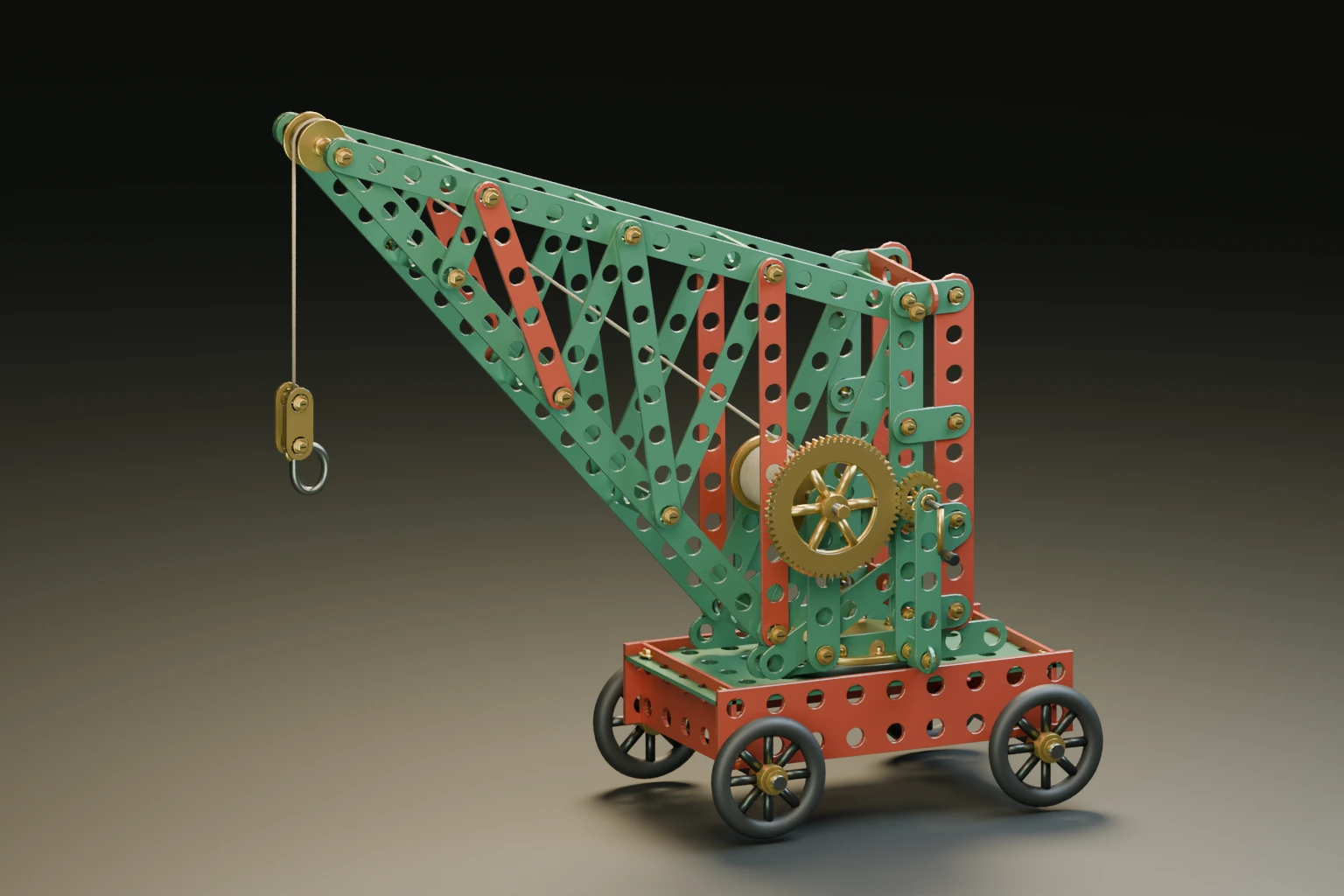
OBJECT 01 / THE MECCANO SET
The little pieces that built a world.
Metal strips, nuts, bolts, tiny tools. Chandrasekhara remembers Mariappa providing an advanced Meccano set, brought home from his wartime stint in England. Narendra remembers a worn-out set with missing parts, and learning alongside PMP to work with what they had.
The habit travelled through generations. Anvitha remembers Meccano among her earliest gifts from her grandfather, and again among his later gifts. Their shared language was building, fixing and understanding things.
“Our entire relationship was built on building, fixing and understanding things”ANVITHA, HIS GRANDDAUGHTER
The Blessed One · printed pages 20–21; 26–29
As remembered by Chandrasekhara and Narendra and imagined afresh!
As remembered by Chandrasekhara and Narendra and imagined afresh!
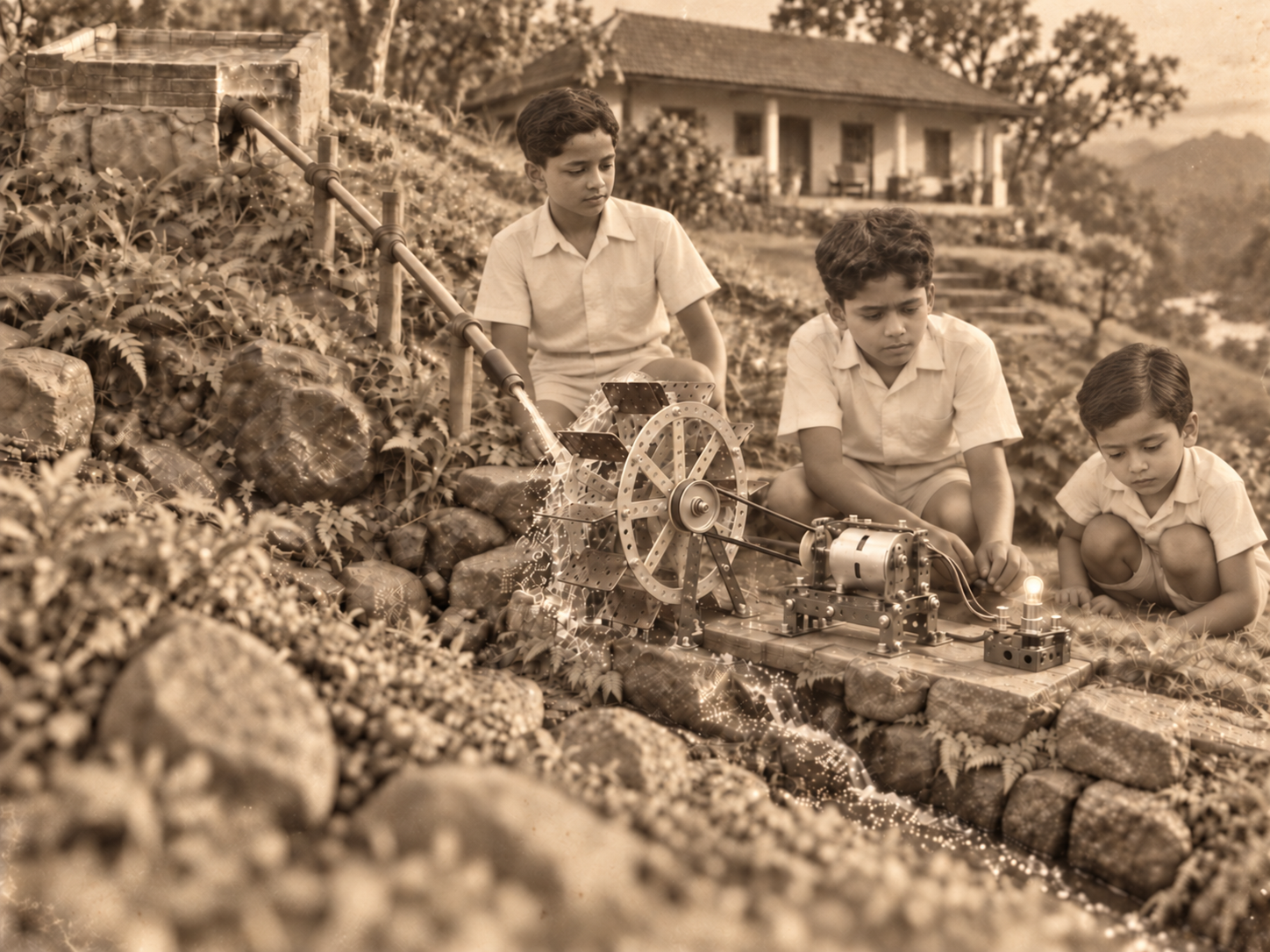
CHANDRASEKHARA REMEMBERS / JOG, 1948–1950
A power station in the backyard.
Behind their government bungalow on a hillock at Jog, Ramakrishna, Prakash and Chandrasekhara used the steep rear slope to build a working model of a hydroelectric project.
Pipes carried water from an artificial tank down the gradient. A water jet struck the blades of a turbine shaped from tin, turning it to drive a generator made with a copper coil salvaged from a hand-ringing telephone generator. A small bulb lit up: their joint venture worked.
Their model echoed the hydroelectric works where their father was installing turbines brought from GE in the UK. He had also provided an advanced Meccano set, with an instruction book that opened up possibilities for many more models.
The Blessed One · printed pages 4–6; 26–27
As remembered by Chandrasekhara and imagined afresh!
As remembered by Chandrasekhara and imagined afresh!
SHIVAKUMAR REMEMBERS / EUROPE, THE 1980s
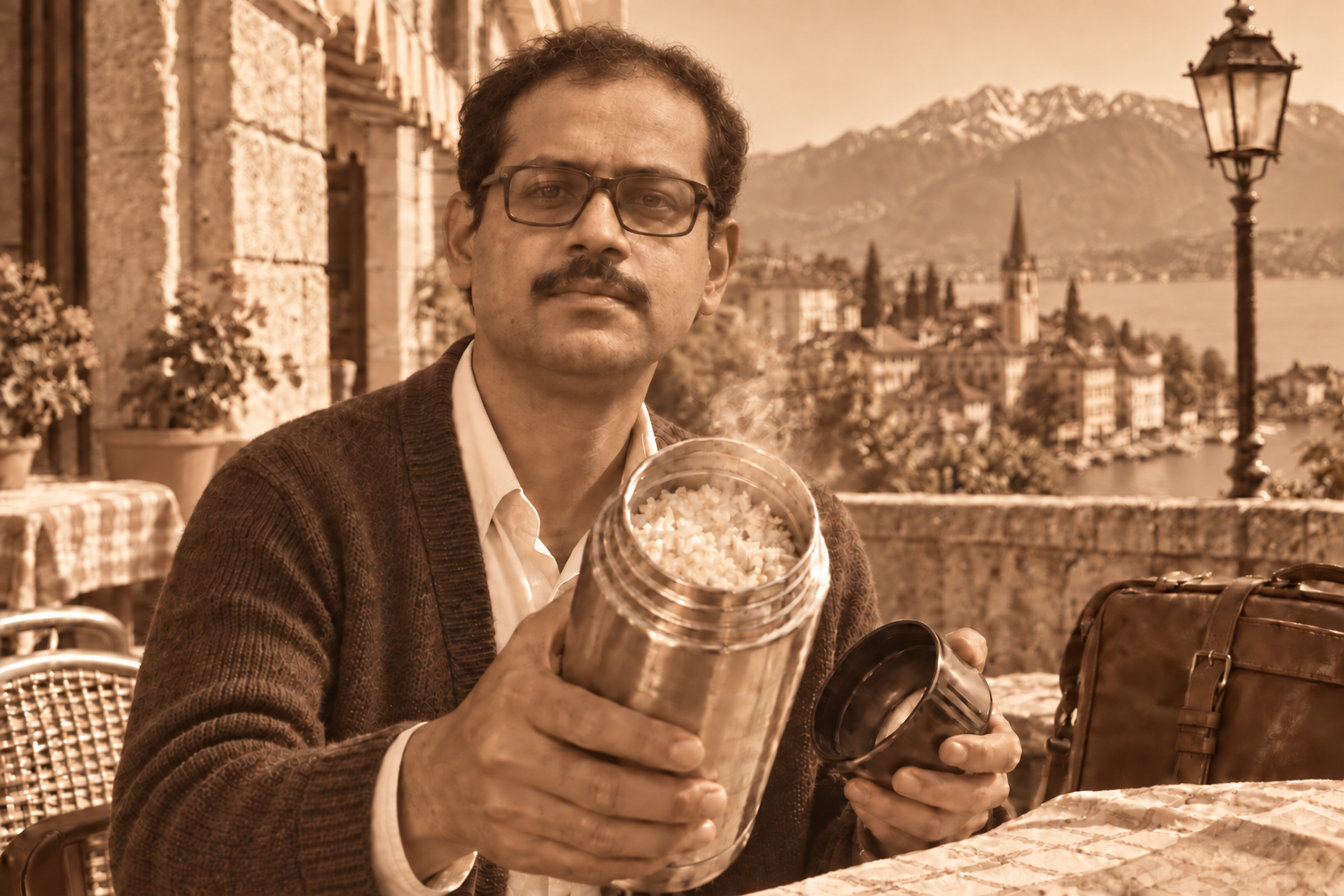
A little ingenuity, even at lunch.
On a European trip in the 1980s, PMP and Shantha missed their familiar rice meals. In Shivakumar’s account, PMP found a solution in the thermos he had packed.
After breakfast he put rice and boiling water into the flask and sealed it. They went sightseeing. By lunchtime, the rice was ready. Chutney pudi, pickles and easily available yoghurt completed the meal.
It is a small story, and a revealing one. The engineer’s instinct was not reserved for the factory. It could make an unfamiliar place feel a little more like home.
The Blessed One · printed pages xiii–xiv
Recollected by Shivakumar and imagined afresh!
Recollected by Shivakumar and imagined afresh!
Bangalore · two intense years beginning at ages 9 and 22
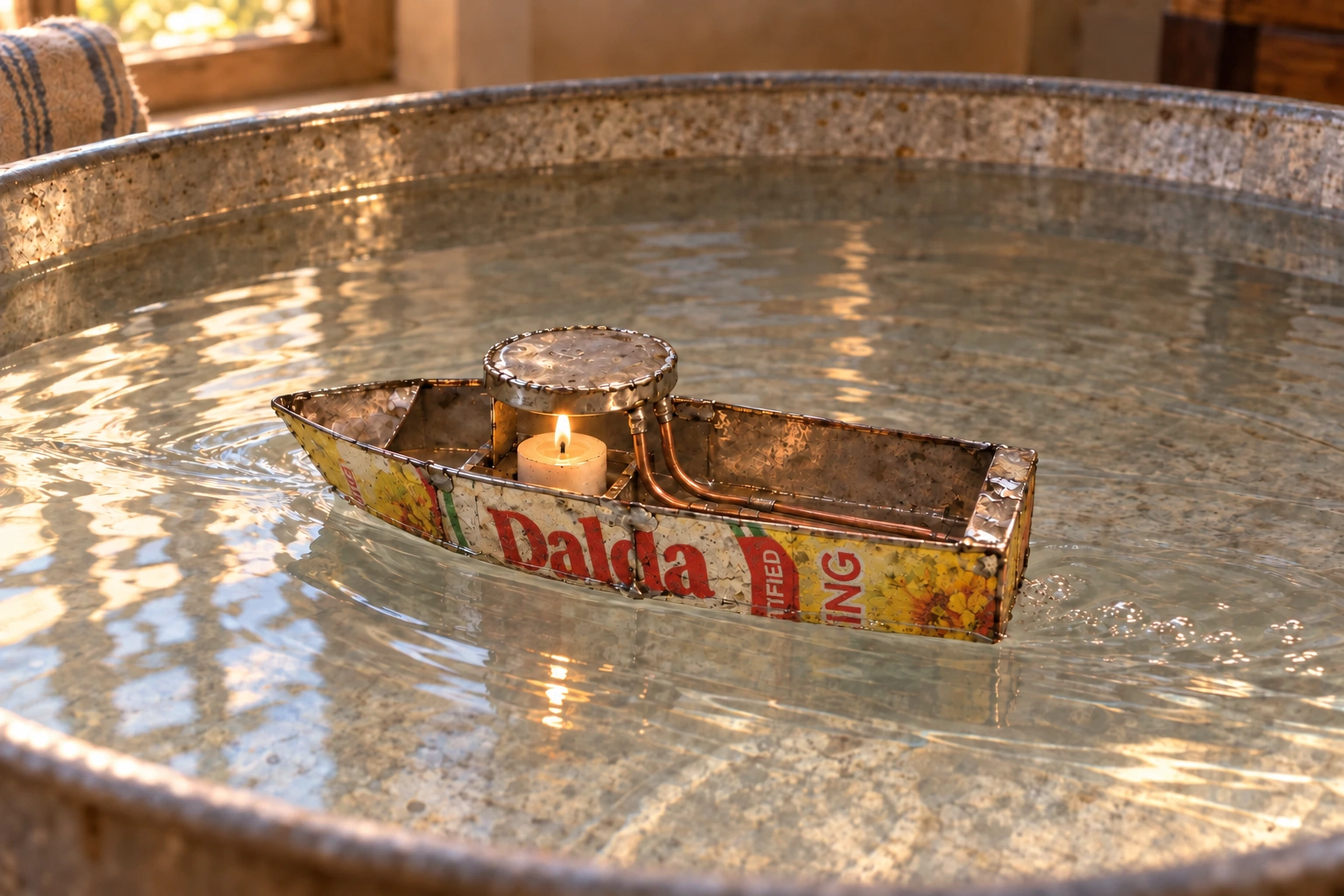
A little steamboat that ran on a candle.
Narendra remembers PMP teaching him to solder. Together, they built several versions of a little boat that ran on a candle.
Tubes, bottle caps, and sheet metal cut from old Dalda cans became a working toy. Once the candle was lit, the boat would putter across the water, powered by heat and their careful soldering.
A tin lid closed by a soldered thin tin membrane formed the boiler. Two copper pipes ran from its underside along the inside floor of the boat and exited through the stern below the waterline. The membrane vibrated as the little engine worked.
The Blessed One · printed pages 29
Recollected by Narendra and imagined afresh!
Recollected by Narendra and imagined afresh!
PMP REMEMBERS / THE MAGIC LANTERN
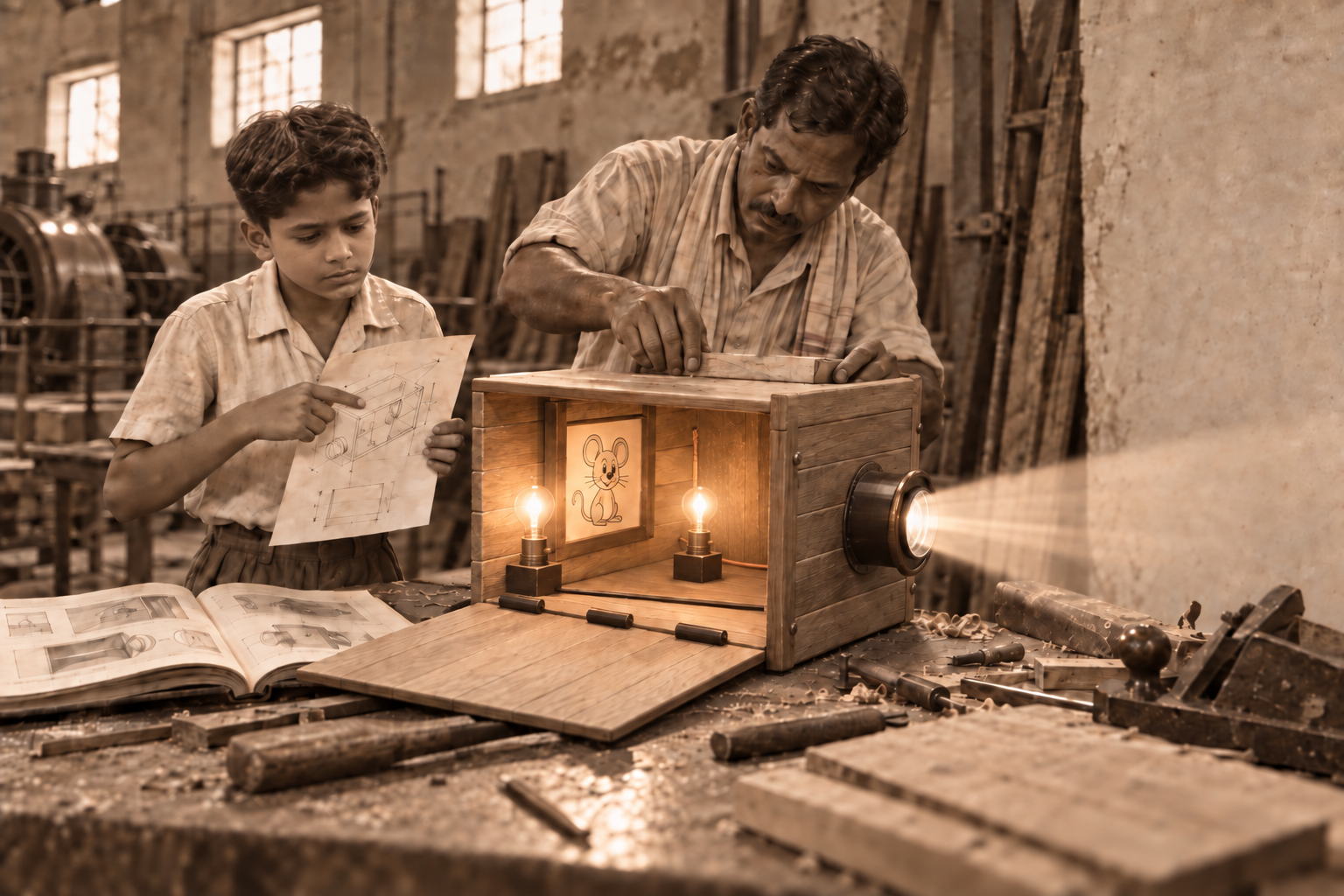
A lantern made from instructions.
PMP remembered the magic lantern as his first do-it-yourself project. His father had brought books from England with complete instructions.
He specified the dimensions to a carpenter at the generating station, wired two 100W bulbs himself, and made do with a smaller lens after travelling 60 miles to Shivamogga on a ration truck.
The project also led to an eyesight correction. Duty engineer Swasbrook noticed PMP holding the drawing close to his face and helped him get to an optician.
The Blessed One · printed pages 4–5
Recollected by PMP and imagined afresh!
Recollected by PMP and imagined afresh!
PMP REMEMBERS / THE 1950s JATRA
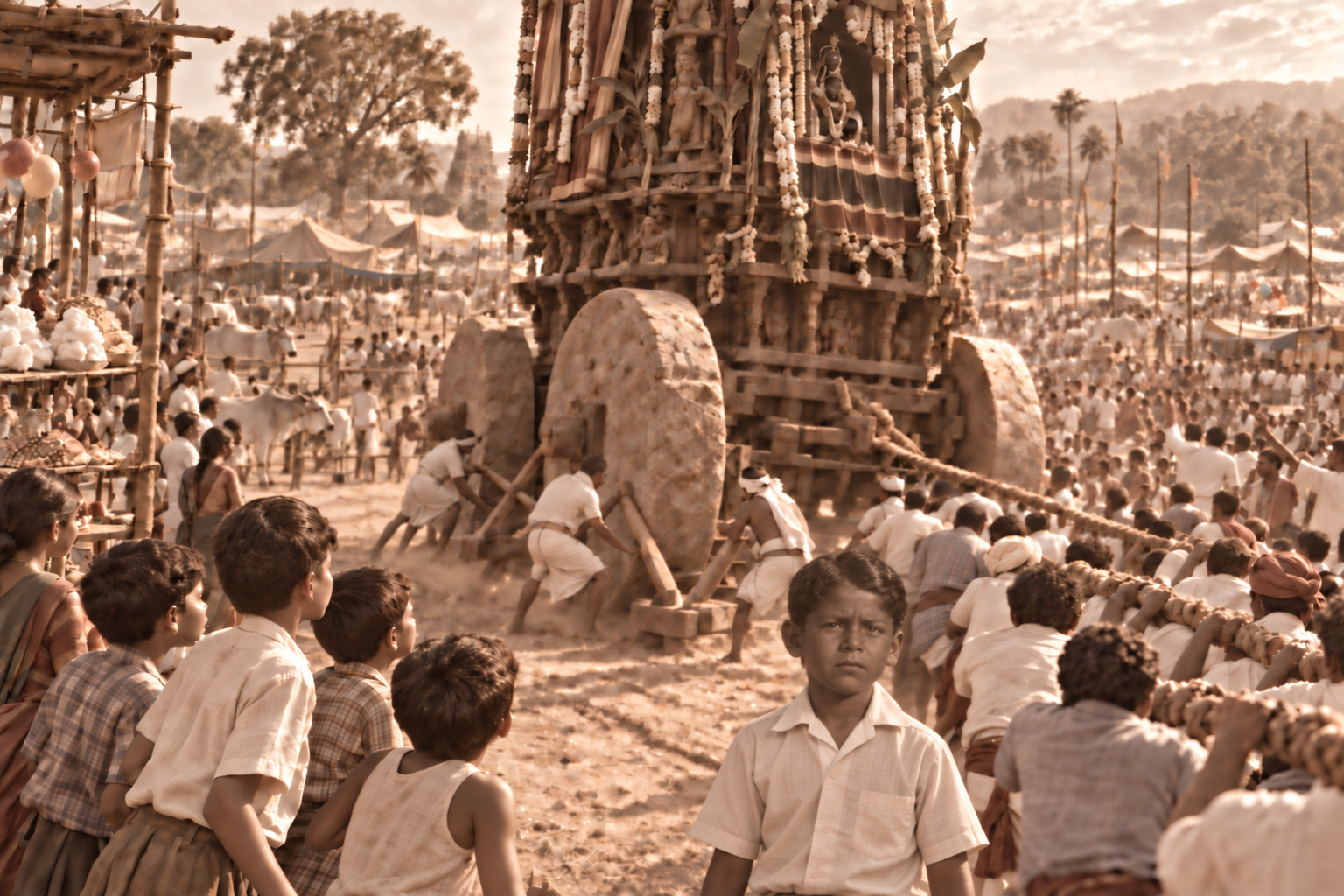
The Jatra that filled the fields.
When Prakash was in fifth standard, he stayed with his grandparents in Nandi. He vividly remembers the Mahashivaratri Jatra that took place just next door, around the Bhoganandeeshvara Temple. It was an annual cattle fair. Cattle arrived 15 days before Shivaratri and stayed a week afterwards in makeshift camps in the fields.
Sweet shops pitched on high platforms sold heaps of kallepuris, bathas, sehe kadale and peanuts. Paper and clay toys, balloons, temporary hotels and a touring talkies made the fair feel festive.
The massive stone-wheel chariots were pulled by rope and controlled with wooden pieces that looked like a plough. Their jerking movement turned the whole chariot, and children shouted around them.
The Blessed One · printed pages 7–8
Recollected by PMP and imagined afresh!
Recollected by PMP and imagined afresh!
Bangalore · two intense years beginning at ages 9 and 22
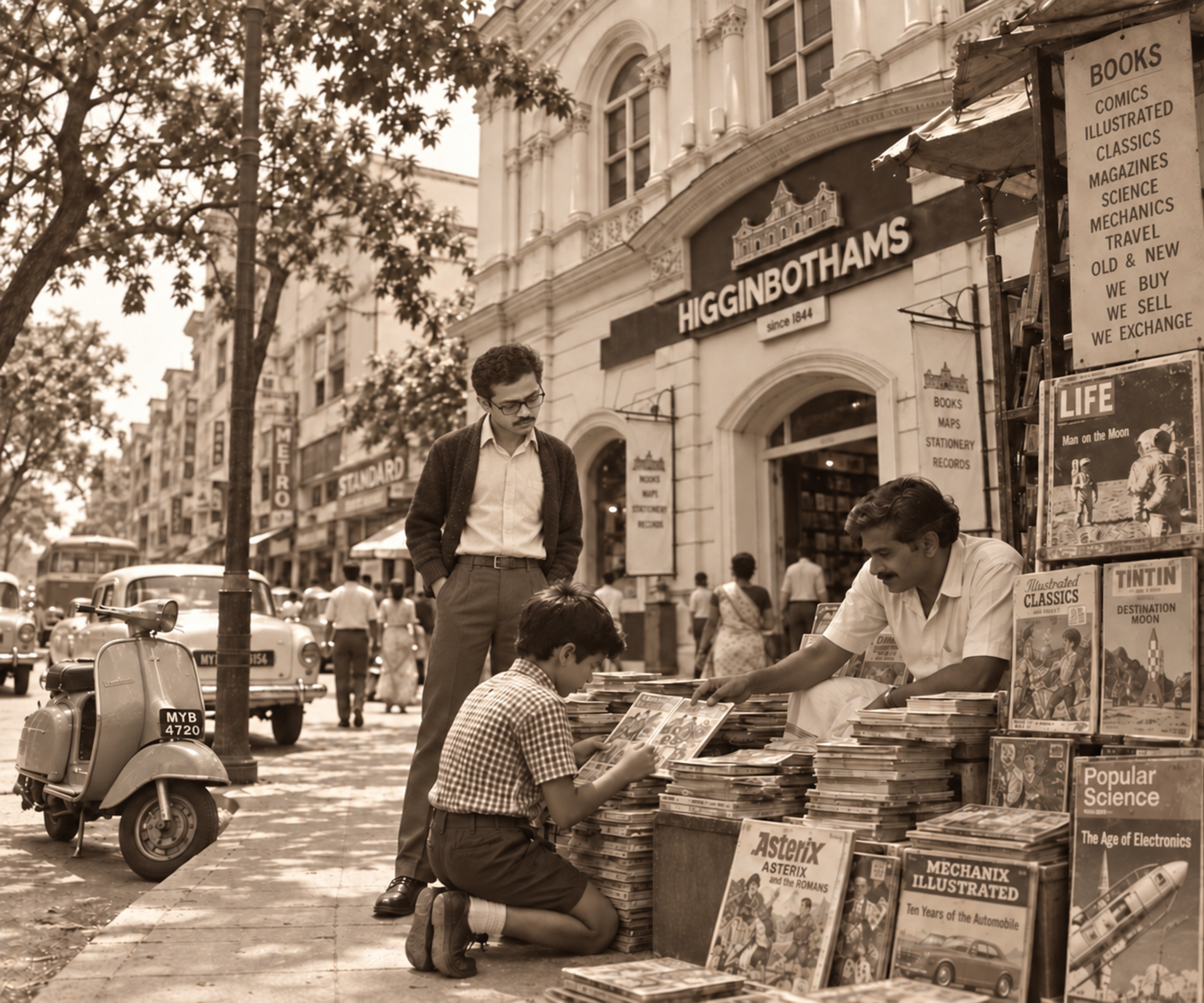
The books that opened the road.
After the family returned to Bangalore, Narendra and Prakash shared two intense years of learning. Narendra was nine and Prakash twenty-two when that period began. Books and comics were part of the same world as soldering, candle boats, the typewriter and radios.
Prakash spent a large part of his income on secondhand books and subscriptions. Popular Science, Popular Mechanics, Reader’s Digest, Time, Life and Popular Electronics filled the shelves. Narendra read every issue front to back.
Prakash introduced Narendra to comics adapted from the classics, then found full-length versions so he could read the originals. That is how his reading life started.
“That’s how my reading life started.”NARENDRA, PMP’S BROTHER
The Blessed One · printed pages 29
Recollected by Narendra and imagined afresh!
Recollected by Narendra and imagined afresh!
Bangalore · two intense years beginning at ages 9 and 22
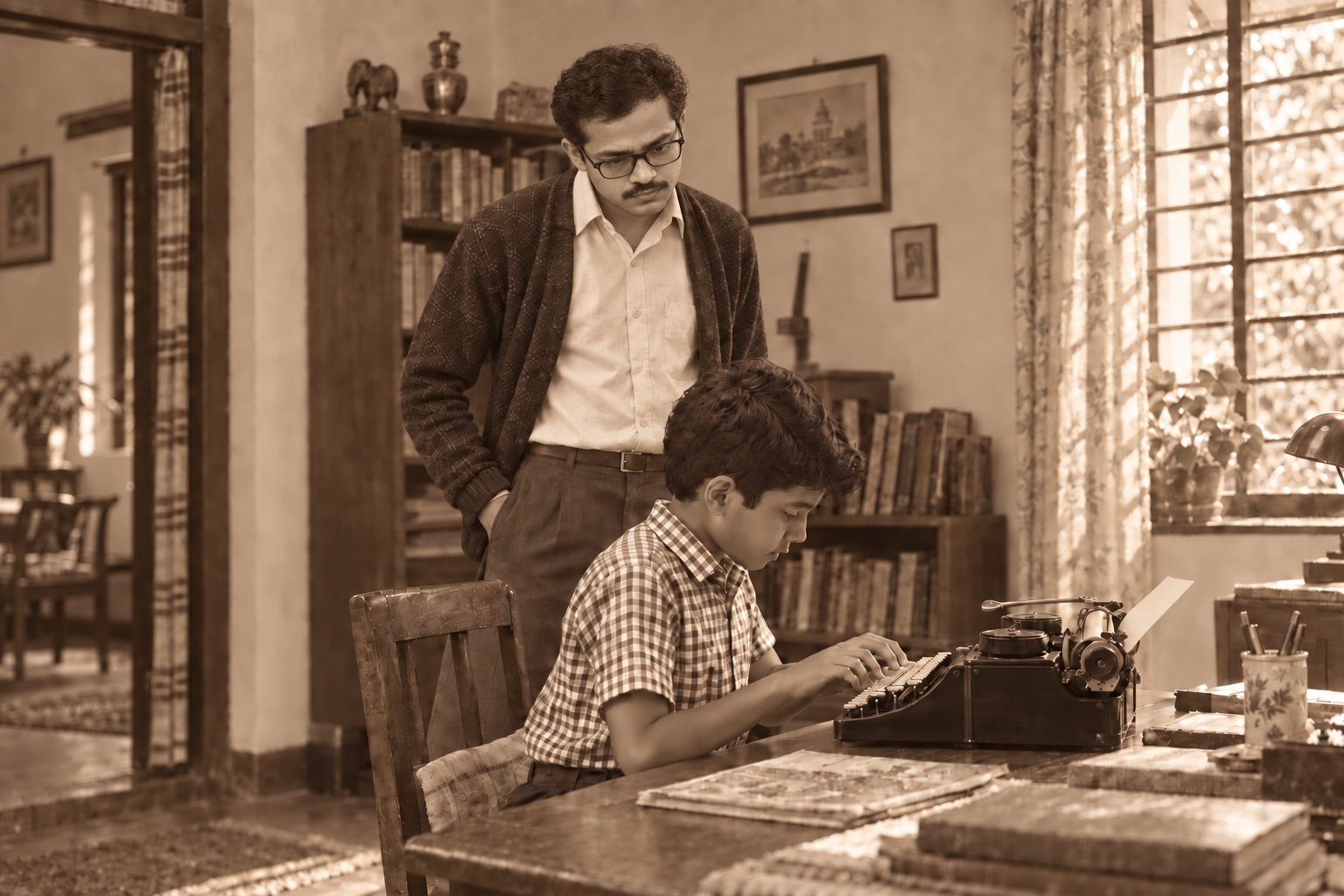
The lesson before the keys.
When Prakash brought home an antique portable typewriter from the ಗುಜರಿ (Gujari), Narendra wanted to play with it at once.
But first he had to memorize the QWERTY layout. Only then was he allowed to even touch the keyboard. Decades later, while others were still hunting and pecking, he was touch-typing as if it were second nature.
Prakash had rewarded striving before gratification. That lesson stayed.
The Blessed One · printed pages 29
Recollected by Narendra and imagined afresh!
Recollected by Narendra and imagined afresh!
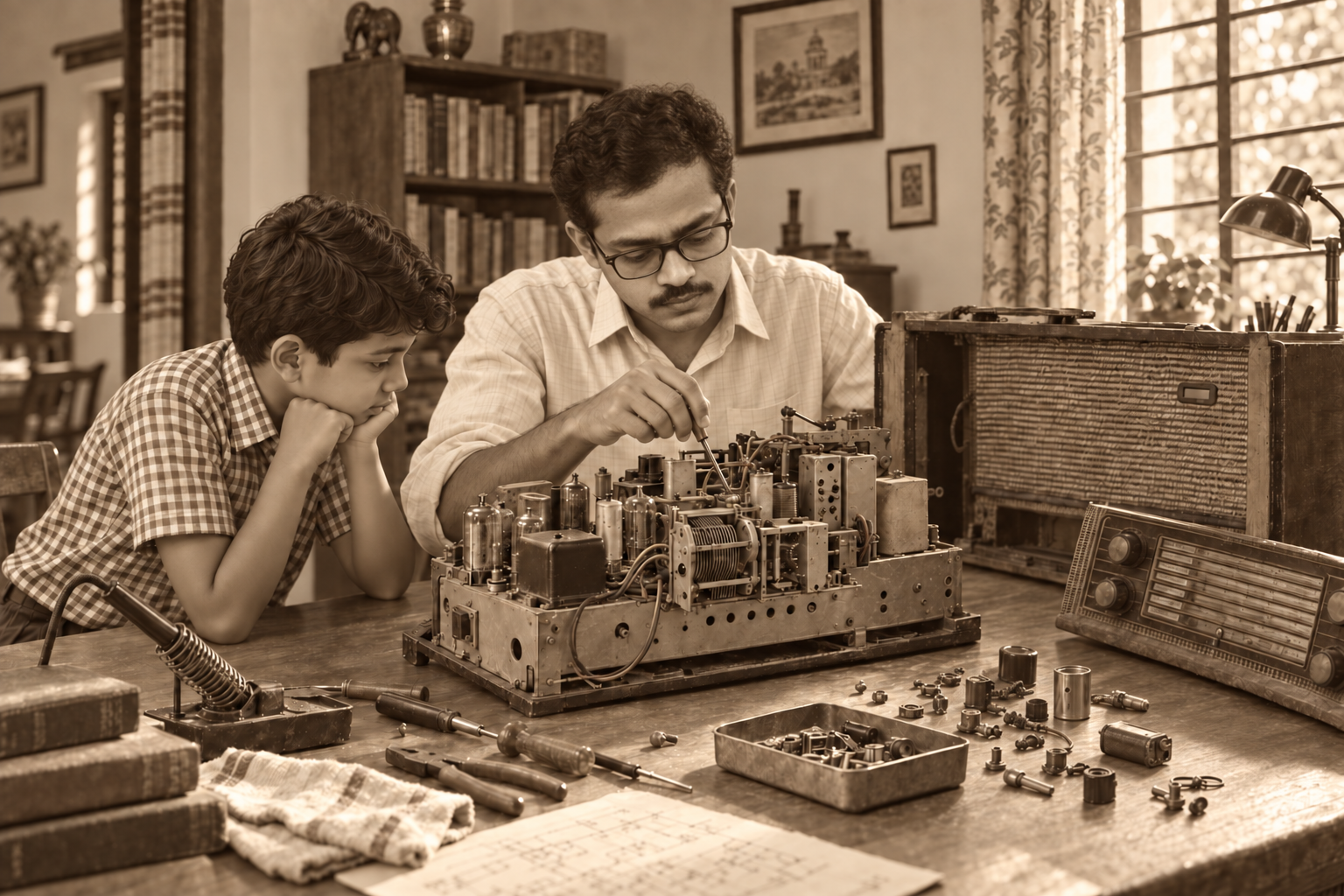
Bangalore · two intense years beginning at ages 9 and 22
Dismantling the family radio to invent auto-tuning.
Narendra’s first radio was a crystal set that Prakash showed him how to build. He later upgraded it with a transistor amplifier.
Then came the family’s (only) radio — their trusty EKCO. Prakash dismantled it to configure a servo-based auto tuner — that showed up in car radios decades later.
Most importantly, it showed enormous confidence in his ability to succeed. At risk was the family’s only source of entertainment. That took a lot of courage! In retrospect, that was a predictor of how he would tackle every new portal in his life.
The Blessed One · printed pages 29
Recollected by Narendra and imagined afresh!
Recollected by Narendra and imagined afresh!
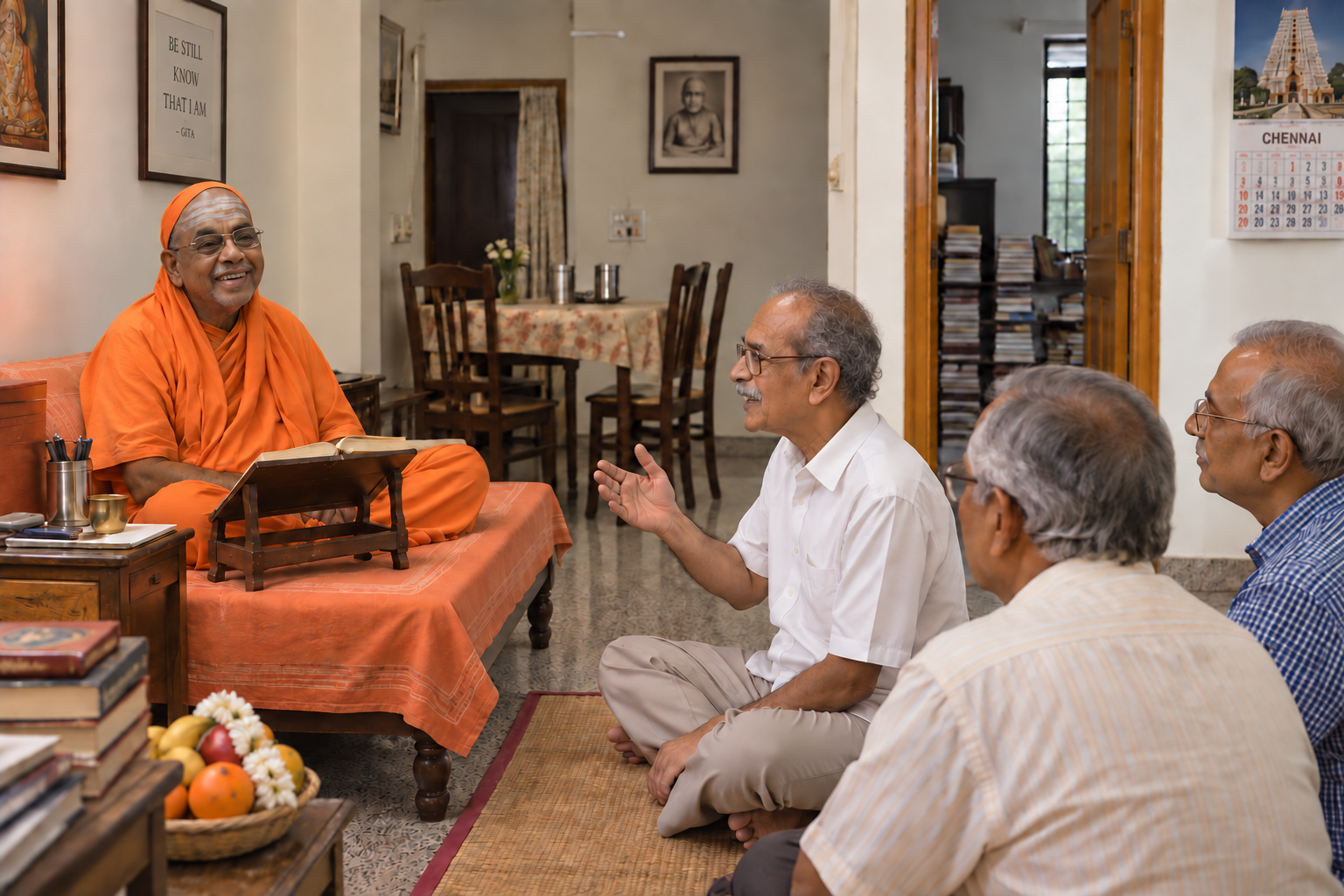
SHIVAKUMAR REMEMBERS / CHENNAI, 2015
A journey for blessings.
After Shivakumar’s Bhagavad Gita summary and English translation reached Swami Paramarthananda, the Swamiji wrote back with his congratulations and blessings. Shivakumar asked for a meeting, and the Swamiji invited them to Chennai.
Prakash, Prashanth, Omprakash and Shivakumar travelled from Bengaluru in 2015. They found the apartment, spent the intervening time at Marina Beach, and returned to ring the bell at the appointed hour.
Prakash told Swamiji that he had completed his Gita study and was now studying the Upanishads. A long friendship, a shared intellectual life and a continuing spiritual practice met in that small Chennai apartment.
“For all of us it was an opportunity of a lifetime.”SHIVAKUMAR, “VISIT TO THE SWAMIJI”
The Blessed One · printed pages xvii–xix
Imagined reconstruction based on Shivakumar’s account.
Imagined reconstruction based on Shivakumar’s account.
SHIVAKUMAR REMEMBERS / NANDI, 2012
A wedding, a dance, and an optical-fibre trench.
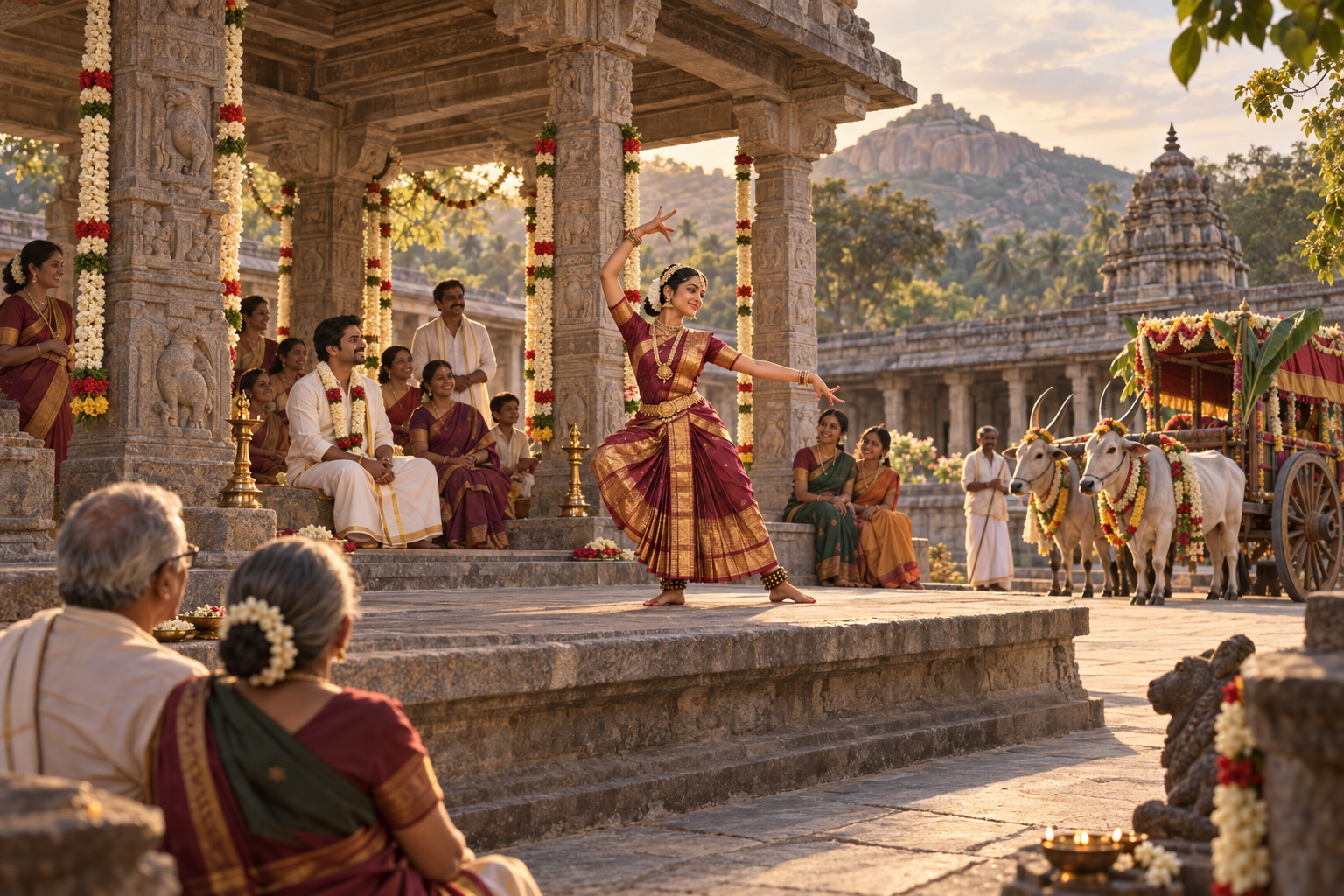
On an Ayudha Pooja visit in 2012 to Discovery Village, Shivakumar and Prakash went to the Bhoganandeeshvara Temple near Nandi. The ninth-century temple and the surrounding hills gave the visit a sense of divinity.
Near Vasantha Mantapa, Subhash shared that his uncle had finally secured permission for his grandson’s wedding to take place there. The bride was an accomplished Bharatanatyam dancer, and the couple wanted her to perform at the mantapa.
They also planned to arrive at the temple in a decorated bullock cart. A newly dug optical-fibre-cable trench across the road made the practical arrangements unexpectedly difficult. On the way back, Prakash explained one more abbreviation: “LT” meant “Living Together.”
The Blessed One · printed pages xiv–xv
Recollected by Shivakumar and imagined afresh!
Recollected by Shivakumar and imagined afresh!
Discovery Village: room for curiosity.
Discovery Village became Prakash’s testing ground for practical innovations.
Cement blocks
Thermos cooking
Heat-transfer film
Tile roofing
Windmill blades
Biogas
Solar heater
Room cleaner
Centralised hot-water system
Room music
Earth
Nurture what grows.
At Nandi, clearing stony ground and planting trees came before further building. The landscape was the first work of care.
Water
Let nothing go to waste.
Rainwater collection, recharge pits and reuse of kitchen water for gardens made conservation part of everyday design.
Fire
Work with the sun.
PMP describes solar water heating and electricity generation as practical ways to reduce dependence on fossil energy.
Air
Leave room to breathe.
Planting thick greenery and keeping televisions out of the cottages encouraged guests to spend time with nature.
Sky
Make space for life.
Open space between cottages, filled with greenery, gave guests privacy and the landscape a chance to remain present.
From the workshop.
A workshop tool: Hand-built winder for the order of 100 transformers.Soldering irons for NGEF.Transformers from the first workshop.
Science you can hold.
Prakash obtained a digital collection of Arvind Gupta’s Toys from Trash and loaded it onto an SD card in a tablet. He selected ten high schools and asked Sikshana Foundation mentors to supervise the model-making.
Gupta’s activities turn everyday materials into experiments in structure, motion and electricity.
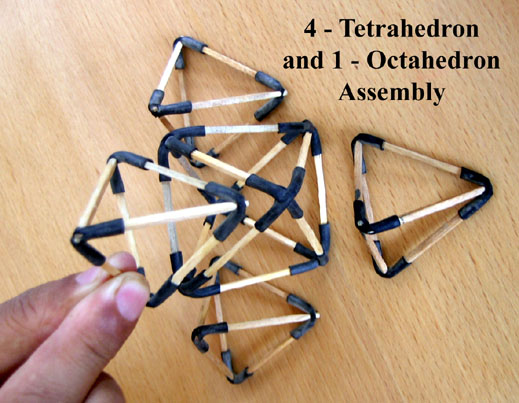
Matchstick structures
Matchsticks and bicycle valve tubing form three-dimensional structures.